Monday, 31 July 2017

Friday, 28 July 2017
What Caused The Mid-Day Selloff?
Join hundreds of advisors from huge brokerage firms like Morgan Stanley, Merrill Lynch, Wells Fargo Advisors, Raymond James and more… see if The Sevens Report is right for you with a free two-week trial.
The most likely “cause” of the midday reversal and selloff (which frankly looked ugly for an hour or so) was a cautious report from JPM quant analyst Kolanovic, and the reasons it caused a dip are twofold. First, Kolanovic is very respected on the Street, and he was one of the first analysts to correctly identify the role of “Risk Parity” funds in the violent market declines of August 2015.
Second, he outright suggested investors hedge equity exposure.
Now, to be clear, it wasn’t a bearish report, as he did note there are strong, positive fundamental factors supporting stocks including a rising economic tide and growing earnings.
However, he made the point that, in his opinion, market volatility is now at an all-time low. The specific accuracy of this claim can be debated, but let’s all agree market volatility is close to, if not at, all-time
lows.
The all-time lows in volatility have caused funds to use increasingly leveraged strategies to generate outsized returns. Selling volatility options is one of the simplest leveraged strategies, but the point is this: Quant funds and traders will ratchet-up leverage in low volatility environments to increase returns amidst perceived lower risk. And, since volatility is at or near all-time lows (and has been for some time) these leveraged strategies are both abundant and large.
And, this all-time low volatility and explosion of leveraged strategies is coming right at a time when global central banks are reducing monetary accommodation for the first time in, well, a decade.
So, while the analogy of fireworks sitting on top of a powder keg is a bit over the top, it does illustrate the general idea behind Kolanovic’s caution.
Bottom line, in my opinion, this report by itself isn’t a reason to materially de-risk, as the same argument could have been made about this market over the past few months (as it’s made new highs). But, Kolanovic is a smart guy, so his caution should be noted.
Finally, two anecdotal points. First, I believe what really spooked markets yesterday was that Kolanovic referenced this current set up as being similar to “Portfolio Insurance,” a strategy that failed miserably and contributed to the crash of 1987. Obviously, that’s not an uplifting analogy.
Second, for those of us watching the tape yesterday, the mini-freefall we saw in tech and specifically SOXX and FDN, was a bit unnerving. Things steadied, but the pace of the declines midday yesterday was a bit scary. That tells me these are very, very crowded trades, and I am going to have a “think” on potentially lightening up some exposure to that tech sector in favor of shifting it internationally (Europe, Japan, and perhaps emerging markets). Food for thought.
Getting back to the markets today, the Employment Cost Index is the key number to watch. If it’s hot, we could see yields rise, and that might pressure stocks mildly. Meanwhile, a soft reading will send yields lower and likely push stocks higher short term. Inflation remains a much more important influence on the markets right now than measures of economic growth.
Time is money. Spend more time making money and less time researching markets every day—start your free trial of the Sevens Report now.
The post What Caused The Mid-Day Selloff? appeared first on Sevens Report.
source https://sevensreport.com/caused-mid-day-selloff/
Thursday, 27 July 2017
FOMC Takeaways, July 27, 2017
FOMC Preview: Get the simple talking points you need to strengthen your client relationships with a free trial of The Sevens Report.
FOMC Decision
• As expected, the Fed left rates unchanged and did not alter its balance sheet.
Takeaway
The Fed decision met our “What’s Expected” scenario, as the Fed said balance sheet reduction “relatively soon,” which is Fed speak for September.
To boot, as was also generally expected, the Fed slightly downgraded the outlook for inflation, saying that inflation was running “below 2%,” as opposed to the previous “running somewhat” below 2%. It’s a minor change that largely reflects the Fed’s recent cautious language on inflation. However, the Fed said that risks to the recovery remained “roughly balanced,” which is Fed speak for “We still can hike rates at any meeting.” That last point is important, because risks remaining “roughly balanced” leaves a rate hike in December on the table (Fed fund futures odds have it at 50/50).
Currency and bond markets reacted “dovishly” to the decision, but again that’s due more to a Pavlovian dovish response to any Fed decision rather than an accurate reflection of the Fed yesterday. In reality, the Fed wasn’t materially dovish.
Bottom line, the policy outlook remains the same: The Fed will reduce its balance sheet in September, and likely will hike rates again in December, barring any economic slowdown or further decline in inflation statistics (at which point both events will become less certain). That was the market’s expectation before the Fed meeting Wednesday, and that’s the market expectation
after the Fed decision.
Join hundreds of advisors from huge brokerage firms like Morgan Stanley, Merrill Lynch, Wells Fargo Advisors, Raymond James and more… see if The Sevens Report is right for you with a free two-week trial.
The post FOMC Takeaways, July 27, 2017 appeared first on Sevens Report.
source https://sevensreport.com/fomc-takeaways-july-27-2017/
Wednesday, 26 July 2017
Cutting Through the Political Noise: 4 Events That Could Actually Cause A Pullback, July 26, 2017
Join hundreds of advisors from huge brokerage firms like Morgan Stanley, Merrill Lynch, Wells Fargo Advisors, Raymond James and more… see if The Sevens Report is right for you with a free two-week trial.
The political noise and theatre has officially reached a new level, with Russia, pardons, impeachment and other such terms of significant connotation being bandied about in the media seemingly every day. And if we were just reading the media headlines, it would cause someone to go into serious risk-off mode in their portfolio, especially given the tenor of the major news outlets.
But as we and others have been saying all year long, the market has so far successfully insulated itself from all the political drama, as it doesn’t have anything to do with earnings or (as of yet) the economy.
We’ve been consistent in our coverage of the political landscape, and I feel that we’ve done a good job cutting through the distracting noise. Yet given the recent uptick in political fervor across the media (including financial media), I think it’s helpful to identify, clearly, what political events could actually cause a pullback in stocks.
Absent one of four events happening (as it stands right now), politics will remain a distraction, but not a bearish influence. To be clear, we do not think any of these events are likely at this time; however, we are watching for any hints they might become more probable and cause us to reduce risk and equity exposure.
Political Pullback Event #1: Trump Fires Mueller. There are rumors and speculation swirling that President Trump will fire Robert Mueller, the special counsel in charge of the Russian election tampering investigation. So far, he is not expected to fire him, but Trump is unpredictable. If Trump were to do it, that would cause a risk-off move in markets, as everyone would take it as a tacit admission of some guilt on Trump’s part (i.e. fire the investigator before he finds something). But even if Trump wanted to fire Mueller, he actually can’t. Only the acting Attorney General can fire Mueller.
But even if Trump wanted to fire Mueller, he actually can’t. Only the acting Attorney General can fire Mueller. So first, Trump would need to fire Attorney General Sessions, and then the deputy Attorney General (Rosenstein). Then he would keep firing people until he found someone in the Justice Department that would fire Mueller. If this sounds familiar, it should, because that is what Nixon did when he fired Watergate Special Counsel Archibald Cox.
Given that history (rightly or not) people and markets would take the firing as a de facto admission of guilt that the president did something wrong, even it it’s not true. To boot, Congress would likely reappoint Mueller to the same job immediately, resulting in a massive stand off between the executive and legislative branches of the federal government. Nothing here would be positive for stocks, and a “sell first, ask questions later” mood could sweep across the markets.
Political Pullback Event #2: Steel Tariffs. The idea that the Commerce Department could impose sweeping steel tariffs (likely aimed at China) is a potential negative for markets, because it could ignite a trade war, which would be bad for US and global economic growth. Whether steel tariffs would result in retaliation from China or other nations remains to be seen, but the fact is
that macro-economic risks would rise, and once again we’d have a “sell first” reaction from stocks.
Political Pullback Event #3: Government Shutdown. We’ve covered this consistently in the report, but the current budget for the operation of the government ends on Sept. 30. Now, the probability of a shutdown remains low because the Republicans control the government. So, they’d literally shut down the government as the majority party a year ahead of elections, a move so politically stupid that it’s almost inconceivable.
However, this is Washington, and right now the budget being advanced through the House contains $1.6 billion in funding for the Mexican border wall, and a lot of cuts to domestic program. So, we can expect united Democratic opposition and (importantly) some moderate Republicans (Collins, McCain) to potentially oppose the budget, which makes passage in the Senate uncertain.
Political Pullback Event #4: Debt Ceiling. Again, this is an event we’ve already touched on in previous issues, but we’re getting a lot closer to the mid-October deadline and there’s been no progress made. Like the government shutdown, political common sense implies this won’t be a problem given it’s politically disastrous for Republicans. Congress has until mid-October to extend the debt ceiling, or face another default drama.
Time is money. Spend more time making money and less time researching markets every day—start your free trial of the Sevens Report now.
The post Cutting Through the Political Noise: 4 Events That Could Actually Cause A Pullback, July 26, 2017 appeared first on Sevens Report.
source https://sevensreport.com/cutting-political-noise-4-events-actually-cause-pullback-july-26-2017/
Tuesday, 25 July 2017
FOMC Preview and Projections plus the Wildcard to Watch, July 25, 2017
FOMC Preview: Get the simple talking points you need to strengthen your client relationships with a free trial of The Sevens Report.
Tomorrow’s FOMC meeting is important to markets for multiple reasons, because it will give us additional color on when the Fed will begin to reduce its balance sheet, and whether a December rate hike is still on the table.
Those revelations will be the latest catalyst for the ongoing battle between “reflation” (which means cyclical sectors like banks, industrials and small caps outperform) or “stagnation” (super-cap tech and defensive sector out-performance).
Given the latter sectors have been the key to outperforming the markets in 2017, understanding what the Fed means for these sectors is critically important. Remember, it was the Fed’s “hawkish” June statement
that saw Treasury yields rise and banks and small caps outperform from June through mid-July. And, it was
Yellen’s “dovish” Humphrey-Hawkins testimony that reversed the rise in yields and resulted in the two-week outperformance of super-cap tech (FDN) and defensive sectors such as utilities. So again, while not dominating the headlines, the Fed is still an important influence over the markets, just on more of a micro-economic level.
What’s Expected: No Change to Interest Rates or Balance Sheet Policy. The Fed is not expected to make any change to rates (so no hike) or begin the reduction of the balance sheet. However, and this is important, the Fed is expected to clearly signal that balance sheet reduction will begin in September by altering the fifth paragraph to state that balance sheet normalization will begin “soon” or “at the next meeting.” Likely Market Reaction: Withheld for Sevens Report subscribers. Unlock by starting your free trial today.
Hawkish If: The Fed Reduces the Balance Sheet. This would be a legitimate hawkish shock, as everyone expects the Fed to start balance sheet reduction in September. Likely Market Reaction: Withheld for Sevens Report subscribers. Unlock by starting your free trial today.
Dovish If: No Hint At Balance Sheet Reduction. If the Fed leaves the language in paragraph five unchanged (and says balance sheet reduction will happen “this year”) markets will react dovishly, as balance sheet reduction likely won’t start until after September, and that means no more rate hikes in 2017. Likely Market Reaction: Withheld for Sevens Report subscribers. Unlock by starting your free trial today.
Wild Card to Watch: Inflation Language.
So far, the Fed has been pretty dismissive regarding the undershoot of inflation, but that may change in tomorrow’s statement. If the Fed reduces its outlook on inflation (implying low inflation isn’t just temporary) or, more significantly, implies the risks are no longer “roughly balanced” (which is Fed speak for we can hike at any meeting), then a December rate hike will be off the table, and that will result in a likely significantly dovish move. If made, that change will come at the end of the second paragraph.
Bottom Line
To the casual observer, this Fed meeting might look like a non-event, but there are a lot of potential changes that could have significant implications on sector performance over the next few months. So, again, getting this Fed meeting “right” will be important from an asset allocation standpoint.
Time is money. Spend more time making money and less time researching markets every day.
The post FOMC Preview and Projections plus the Wildcard to Watch, July 25, 2017 appeared first on Sevens Report.
source https://sevensreport.com/fomc-preview-projections-plus-wildcard-watch-july-25-2017/
Monday, 24 July 2017
Weekly Market Cheat Sheet, July 24, 2017
Join hundreds of advisors from huge brokerage firms like Morgan Stanley, Merrill Lynch, Wells Fargo Advisors, Raymond James and more… see if The Sevens Report is right for you with a free two-week trial.
Last Week in Review
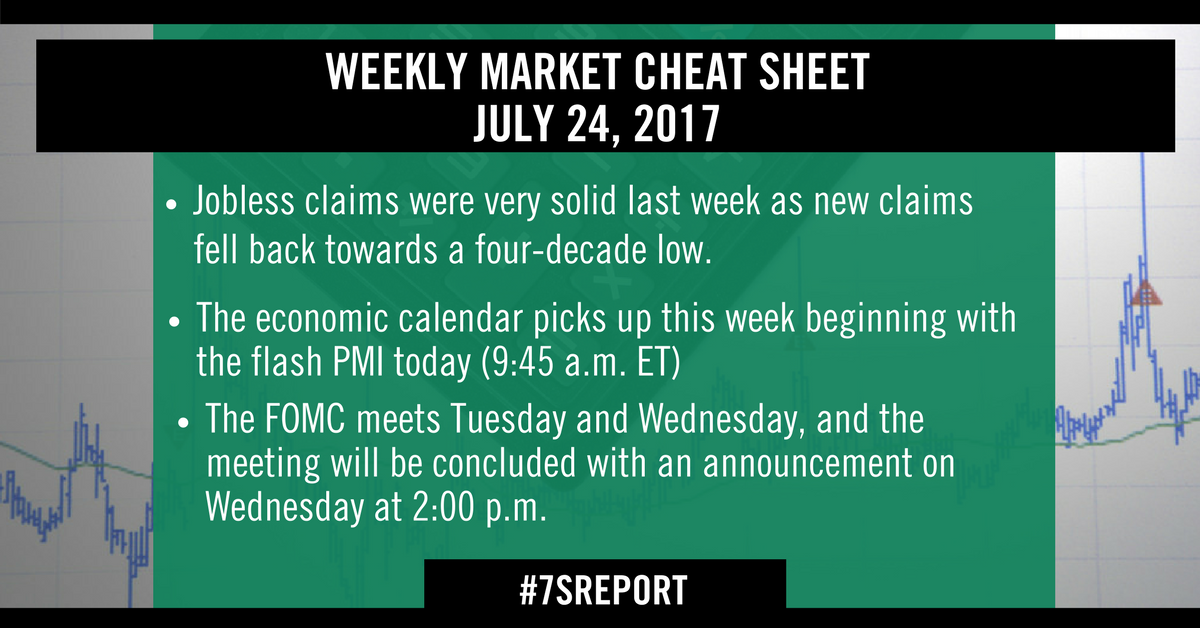
The economic calendar picks up this week beginning with the flash PMI today (9:45 a.m. ET), as we continue to get an initial look at the July data. So far, the data has been a bit underwhelming as both the Empire and Philly Fed surveys came in light last week.
As far as hard data goes, Durable Goods comes out Thursday, and the preliminary second-quarter GDP number comes out Friday.
Housing data also picks up this week, and after last week’s mixed results (remember the Housing Market Index missed but Housing Starts was solid) economists will be looking for a better read on the current status of the real estate market. The two big reports this week are Existing Home Sales on Monday, and New Home Sales on Wednesday. However, the S&P CoreLogic Case-Shiller HPI also will be worth watching (due out Tuesday). If the housing data is more in line with the strong Housing Starts data we saw last week, that will be an underlying positive for the economy and supportive for risk assets near term.
Turning to the central banks, the FOMC meets Tuesday and Wednesday, and the meeting will be concluded with an announcement on Wednesday at 2:00 p.m. There are no material changes expected to come from the meeting, and it would be a shock if rates were not left unchanged. There is no press conference or forecasts released with this meeting, but language in the statement will be closely watched for any further clues on the Fed’s plans to reduce the balance sheet, or on when rates will be raised. Right now, expectations are for a December hike, but based on the trend in other central bank rhetoric the risk is for a dovish development due to the complete lack of inflation acceleration.
This Week’s Preview
Economic data was thin last week, but we did get our first look at July data in the form of regional Fed outlook surveys as well as a few reports on the housing markets.
Beginning with the Fed surveys, the Empire State Manufacturing Survey was released on Monday, and despite the bad headline it was not a terrible report. The headline missed estimates (9.8 vs. E: 15.0), but the forward looking New Orders component remained solidly above 13. The reason the report was not that bad was the fact that it had started to run hot at unsustainable level recently, and was due for a dip. And the correction we saw in the June data wasn’t too deep, and the details remained encouraging.
The Philly Fed Survey out on Thursday was not as bad a miss as the Empire data on the headline (19.5 vs. E: 22.0), but the details definitely dimmed the outlook for the Mid-Atlantic manufacturing sector. The forward-looking component of the report, New Orders, fell more than 20 points to just 2.1. The survey Philly data last week finally started to show a decline in enthusiasm from the extremely strong survey reports we’ve seen since the election. If these reports are foreshadowing a pullback in the broader US economy, that would be very bad for stocks, as solid growth is still priced into the market at current levels.
Housing data was mixed last week as the Housing Market Index missed expectations, but Housing Starts and Permits were very solid. Data on the real estate market has been all over the place recently, and it will take more data to try to decipher where the trends actually are in the sector. But if the strong Starts and Permits data from last week are any indication (this is a more material data point than the Housing Market Index) that will be a sign of confidence in the US economy.
Lastly, jobless claims were very solid last week as new claims fell back towards a four-decade low. The very positive weekly report was significant, because the data collected corresponds with the survey week for the July BLS Employment report. So, based on jobless claims alone we can expect another very strong official employment report early next month.
Time is money. Spend more time making money and less time researching markets every day.
The post Weekly Market Cheat Sheet, July 24, 2017 appeared first on Sevens Report.
source https://sevensreport.com/weekly-market-cheat-sheet-july-24-2017/
Friday, 21 July 2017
ECB Announcement Takeaways—July 21, 2017
The Sevens Report is everything you need to know about the markets in your inbox by 7am, in 7 minutes or less. Start your free two-week trial today and see what a difference the Sevens Report can make.
ECB Announcement Takeaways
- The ECB left key interest rates unchanged.
- The monthly QE program remains 60B euros
- Forward guidance was left unchanged from the June statement.
Takeaway
As expected, the ECB left all major policy decisions as they were at the July meeting, including interest rates, QE and a lack of any material new forward guidance. The initial reaction to the statement was dovish, as policymakers appeared to simple “kick the can” toward the September meeting.
But, Draghi’s press conference following the statement offered more mixed signals. First, the ECB President reiterated his upbeat view of the European economy, which is slightly hawkish, but did mention that he and other policymakers remain cautious about the lack of inflation. To that point, Draghi repeated his pledge to increase QE in both size and duration should the economy falter or financial conditions worsen. This was largely expected, but it offered a dovish reminder. At this point in the press conference, the release was still a wash.

The catalyst for the surge in the euro, which gained well over 1% in intraday trade, was actually due to the lack of attention Draghi gave to the recent strength in the currency. He had several opportunities to address the recent gains in the euro, which hit multi-year highs earlier this week.
Yet the failure to do so was enough for currency traders to chase the shared currency up to new highs.
Bottom line, the ECB effectively “kicked the taper can” to the September meeting, which means unless Draghi verbally suggests otherwise between now and then, any changes will likely be very subtle (i.e. modest taper to QE but extended duration). That was underscored by the fact that the 10-year bund was essentially unchanged yesterday. Looking ahead, the ECB still is a long way off from actually tightening policy (as they are technically still actively easing with their QE program) and as such, the rally in the euro is getting a bit extended. Nonetheless, the trend remains bullish for the euro, and until there is a catalyst such as blunt, less-dovish commentary from Draghi or a spike in EU inflation, then the path of least resistance will remain higher for the euro.
Help your clients outperform markets with The Sevens Report. Start your free two-week trial today.
The post ECB Announcement Takeaways—July 21, 2017 appeared first on Sevens Report.
source https://sevensreport.com/ecb-announcement-takeaways-july-21-2017/